InterBattery 2026: What I Saw in Seoul That Changes the European Battery Calculus

I spent the past week at InterBattery in Seoul — walking the floors, sitting across from engineers and business development teams, and following up on partnerships between European battery startups and Korean manufacturers. Here is what actually happened, and why it matters for how you should be thinking about your battery supply chain right now.
It Was Bigger. Meaningfully Bigger.
75,000 visitors. That is not a rounding-up-to-sound-impressive number — the difference in energy from last year was visible in the halls. Last year, InterBattery felt predominantly domestic: Korean technology, Korean customers, Korean conversations. This year had a distinctly different character. European delegations, American companies, and Australian buyers. The West had arrived — not as curious observers, but as people actively looking for something.
What They Were Looking For
In conversation after conversation with European partners, the framing was consistent: they want either a 100% non-Chinese supply chain, or at a minimum, manufacturing that does not touch China. Not because of a regulatory requirement that has arrived yet, but because of one they expect to arrive — and because of a commercial and reputational risk they are increasingly unwilling to carry.
The mood was not panicked. Companies that had accepted Chinese supply chain exposure as a pragmatic reality two years ago are now running structured programmes to reduce it. Korea — with its manufacturing depth, quality credentials, and geopolitical positioning — is the most obvious destination for that shift. It was deliberate repositioning.
If you are a European battery startup and your supply chain still runs through China in ways you cannot fully account for, the window to restructure it on your own terms is open now. It will not stay open indefinitely.
The Conversation That Didn't Happen: EVs
Almost none of my conversations at InterBattery this year were about electric vehicles. That is worth pausing on, because a year ago, the EV conversation still dominated.
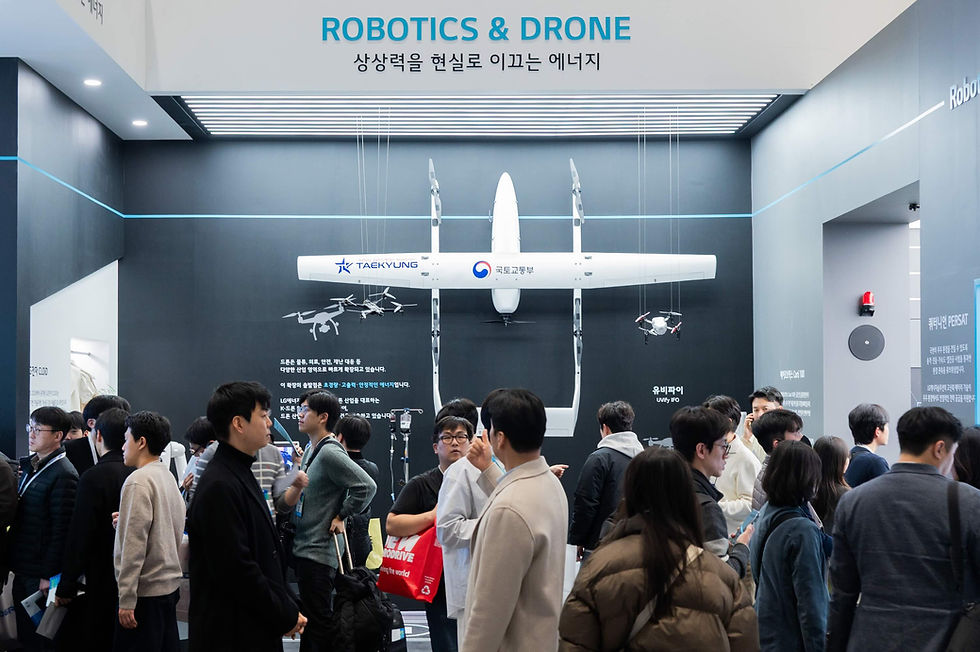
What replaced it: drones. The defence and autonomous systems sector has arrived at batteries with genuine urgency — and a fundamentally different set of requirements from automotive. Energy density matters more. Supply chain provenance matters enormously. Local manufacturing, or at least close-geography manufacturing, is becoming a procurement criterion rather than a preference. One partner I spoke to put it bluntly: they need batteries made somewhere they can trust, and they need them soon.
For battery startups positioning around EV offtake, this is both a challenge and an opportunity. The drone and autonomous systems market is not the same customer, does not have the same volume ramp timeline, and will not forgive the same technical compromises. But it is a market that is buying now, at margins that are not subject to the same commodity pressure as automotive cells.
The Morrow–JRES Partnership: Why This One Is Interesting
The announcement I watched most closely was the MOU signed between Morrow Batteries and JR Energy Solution at InterBattery this week. For those who don't know the companies: Morrow is a Norwegian LFP and LNMO cell manufacturer with a 1 GWh facility in Arendal; JRES is a South Korean electrode foundry — Korea's first — operating at 500 MWh with expansion plans that reach multi-gigawatt scale.
What makes this particular partnership structurally significant is not the size of the MOU. It is the model. JRES is explicitly positioning itself as the TSMC of batteries — offering electrode foundry services to cell makers who need flexible, scalable manufacturing without the €200M upfront capital commitment required to build their own electrode line. Morrow brings manufacturing infrastructure, additional cell formats and proprietary chemistry. Together, they are building something Europe genuinely lacks: an open, flexible electrode manufacturing capability that startups can access on commercial terms, with technology transfer built in rather than outsourced.
It is a proof of concept for how European battery innovation reaches production at scale without either burning its capital on infrastructure or handing its IP to a Chinese manufacturer. If it works — and I think the structural logic is sound — it becomes a template.

Why I'm Staying Another Week
I am remaining in Korea for another week to follow up on the partnerships that came into view during InterBattery. Specifically, I'm working on connections between JRES and European battery startups that have validated chemistry but no visible path to scaled production.
If that describes your company, you have technology that works, your pilot data is solid, but your manufacturing path either doesn't exist or runs through a supply chain you'd rather restructure — this is the conversation to have now, while the Korean side is actively looking to build exactly these relationships.
I can make the introductions directly. Reach out.


